Skill Mapping in the Circular TwAIn Project
3 minute read
The Circular TwAIn project is redefining workforce optimization by integrating AI technologies into the industrial ecosystem. At the heart of this transformation lies Clawdite, our versatile platform, which plays a pivotal role in the Human Digital Twin (HDT) component. One of the project’s key achievements is the successful mapping of operator skills to the O*NET Content Model, enabling smarter and more efficient workforce management through AI-powered task assignment.
Mapping Operator Skills with O*NET
To model and standardize operator skills, we leveraged the O*NET Content Model (O*NET Content Model), a comprehensive taxonomy designed by the U.S. Department of Labor. This model serves as a structured foundation to describe work and worker characteristics in a consistent and analyzable format.
In Clawdite, the mapping process employed AbstractDescriptors to associate high-level worker data with O*NET taxonomy items. This design enables us to:
- Model skills as characteristics,
- Link each skill to a corresponding taxonomy item, and
- Connect each taxonomy item to a known Taxonomy instance, representing the O*NET model.
By structuring data this way, Clawdite makes it straightforward to retrieve an operator’s skills while filtering out unrelated characteristics (like age or height) stored in the HDT.
An Enriched Data Model for Clawdite
To support this advanced skill mapping, Clawdite’s data model was extended to:
- Represent skills and values in alignment with a given taxonomy (O*NET),
- Track task assignments and include a mechanism to model exemptions—tasks that an operator is explicitly prevented from performing.
Tasks, or interventions, are considered assignments issued by an orchestrator (e.g., a manager) to a factory entity (a worker). The new Exemption concept allows us to annotate specific cases where an operator cannot perform a task, further enhancing the precision of task assignment.
Introducing the Operator2Task Assignment Module
Building on this skill mapping infrastructure, within the Circular TwAIn project our lab developed the Operator2Task Assignment module. This AI-driven component intelligently matches workers to tasks based on skill compatibility, making it a cornerstone for efficient workforce orchestration.
Key Capabilities
- Skill Profiling: The HDT continuously records operator skills and task history, creating a comprehensive profile.
- Task Analysis: When task requirements are not predefined, the system uses AI (language models) to analyze task descriptions and infer needed skills via sentence embeddings.
- Vector-Based Matching: Both operator profiles and task descriptions are converted into vectors. Using similarity metrics (e.g., cosine similarity), the system computes a compatibility score.
- AI-Powered Recommendation Engine: The module suggests the best-matching worker for each task, along with a confidence score to aid decision-making.
This approach ensures not only that the most suitable operators are assigned to each task but also promotes higher job satisfaction by aligning tasks with workers’ strengths.
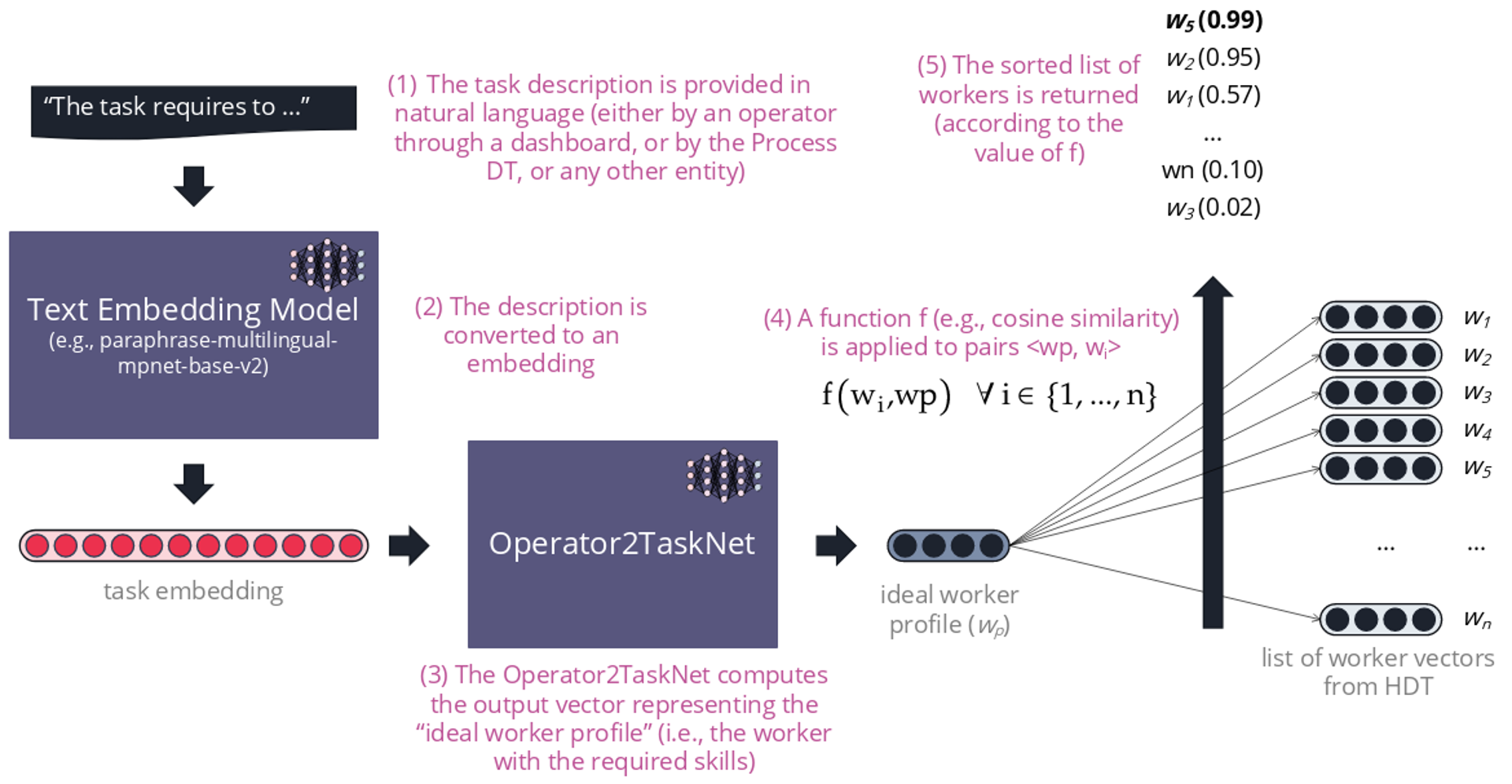
The AI pipeline implemented by the Operator2Task Assignment module
Conclusion
By enriching the Clawdite platform with skill mapping aligned to the O*NET Content Model and integrating AI for intelligent task assignments, the Circular TwAIn project is paving the way for next-generation workforce management. The Human Digital Twin becomes not just a data repository, but an active, intelligent system that transforms how organizations allocate human resources—optimizing efficiency, ensuring worker satisfaction, and embracing the power of AI in industry.
For more information about the project, visit the official site: circular-twain-project.eu
This work has received funding from the Swiss State Secretariat for Education, Research and Innovation (SERI) and has been partly supported by the European Union’s research and innovation programme under project Circular TwAIn (Grant n. 101058585).